
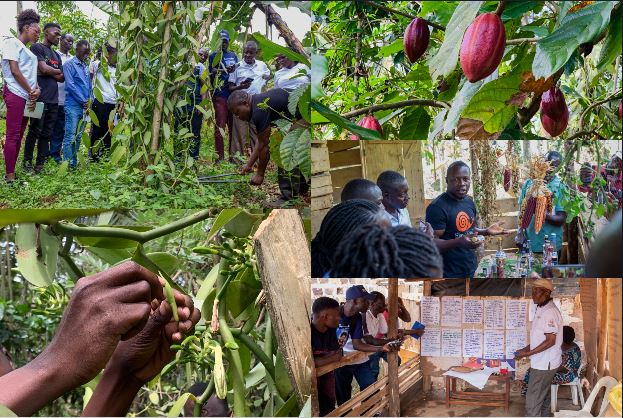
Down in Kisoga town, in the southern stretch of Mukono District, Central Uganda, a farming family is organically regenerating soil fertility, restoring agricultural farm lands and generating steady revenue from numerous ventures on the farm.
Whether it is selling organic soil amendment products manufactured in their backyard or getting a share of the booming cocoa and vanilla markets, the Magala family, headed by Mr. Christopher Magala, is a testament to agriculture being the backbone of Uganda’s economy.
Each member of the family is directly or indirectly involved in the family business which has over the years transformed from the ordinary subsistence farming to intentional agroecology thanks to empowerment through skills training and exposure learning availed by the Eastern and Southern Africa Small-scale Farmers’ Forum – Uganda (ESAFF Uganda).
ESAFF Uganda, operationalized in 2008, is part of ESAFF formed in 2002 during the World Summit on Sustainable Agriculture held in Johannesburg, South Africa by small-scale farmers.
ESAFF Uganda was created to – as is the ideal of the mother entity – to make small-scale farmers seen and heard, to have a farmer-led movement that looks out for small-scale farmers’ interests in a world that largely values and focuses on large-scale commercial agriculture operators.
The movement is anchored on the ideals of agroecology and is a platform through which farmers’ operational and development concerns are aired out and addressed by line stakeholders.
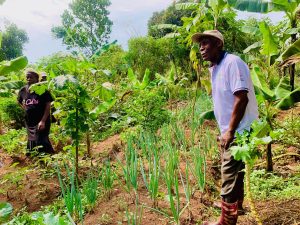
ESAFF Transforms farmers one training at a time
While the Forum aims at building just and resilient food systems, securing fair economic opportunities and productive resources for small-scale farmers, members of the Magala family – just a fraction of the 765,560 individual small-scale farmers under ESAFF Uganda – say the skills training in agroecology has been critical in their business.
Learning the science of regenerative agriculture practices, according to Magala, has changed how he approaches farming from production to consumption.
“I was born in a farming family and our major crop was coffee, sugarcane and bananas. We picked coffee from the fields to be able to afford scholastic materials, so agriculture has been important to me from the get go. I majored in agriculture in secondary school and later joined Arapai National Agricultural College,” he narrates.
While school focused on the modern and commercial agriculture systems, back home on the field, Magala knew something more had to be done other than feeding inorganic fertilizers into the soil which affected its capability to produce yield in the long run among other devastating effects.
Magala’s further studies in Wuhan – China and the Netherlands were an eye opener to the organic ways of agricultural production and once back home, incorporating these into his farm land became more than just a need but a passion.
“We were using all kinds of dirty pesticides to spray our crops here. When I came back, I had acquired the knowledge but was still limited on implementation. That’s when ESAFF Uganda came in and I joined the forum. We made farmers’ groups where we started to learn and practice agroecology and turned away from conventional agriculture practices that weren’t beneficial long term,” he adds.
He notes that the journey to agroecology adaptation was a long one because not everyone, even members of his family, was willing to change from the quick, short-lived gains of conventional agriculture to the lengthy and painstaking regenerative agriculture processes.
“It took my own wife years to finally be on the organic side of operation, then my daughter Irene (Nakijoba) and the rest. But because ESAFF was hands on with the farmer groups, creating awareness on the benefits of agroecology and teaching us how to adapt, we finally agreed to take the leap of change,” Magala notes.
The Magalas Success Story
In 2024, agriculture – including forestry and fishing – contributed approximately 24.67% to Uganda’s GDP. The agricultural sector is still Uganda’s leading source of livelihood, employing about 65% of the working population according to statistics from the Ministry of Agriculture, Animal Industry and Fisheries.
However, with the increase in population and the skyrocketing demand for food, more farmers are opting for commercial agriculture to satiate the need – against organic practices meant to keep the soils fertile and able to produce yield naturally – which in the long run affects soil fertility and structure.
Abandoned farm lands are a common find in areas where large scale agriculture has been practiced over time.
To the Magalas, procuring these pieces of land at a relatively cheap price “considering their perceived infertility” and amending them organically back to fertility has been a rewarding venture.
“Our farm looks disorganized and it’s for a scientific reason. Some sections are left to rest for a year or so, others are awaiting tilling when the rains come, others are undergoing active amendment. We have bought some pieces of land that the owners swore couldn’t grow anything but our matooke is thriving on them. It’s all about adhering to the principles of agroecology,” said Mukiibi, son to Magala during a field study for the Agroecology School for Journalists and Communicators in September.
Mukiibi noted that soil amendments are added to the soil to among others; balance the PH, reintroduce and build up nutrient content, improve the soil’s texture and structure and reinforce water retention or drainage.
“We have overtime created our own seed bank, meaning we are sure of the viability of the seed we use for multiplication, we know which variety thrives where because we have done these tests and overall, the farm is doing better thanks to our decision to follow agroecology guidelines,” Mukiibi added.
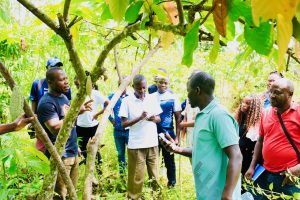
According to Irene Nakijoba, daughter to Magala, learning to make their own organic pesticides and fertilizers is a great win for the farm, the community and the very last consumer of the farm produce because one is assured of food in its natural state.
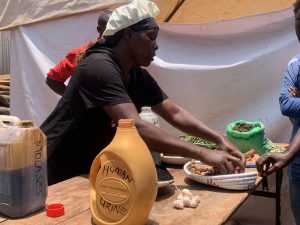
“We are making bio-fertilizer, bio-pesticides and bio-stimulants. All these are meant to revitalize the soil especially here in Central Uganda where our soil has lost much of its organic nutrient content. There is heavy chemical load in the soils and our target is to neutralize that,” Nakijoba notes.
Long term goals
The family is already earning decently from farm produce, farm inputs sold to other farmers and a restaurant business that gets supplies from the very farm among other avenues.
While this is huge success for a small-scale farmer, the Magalas are focused on making soil health and fertility an achievable milestone for every farmer in need.
Most of the technical members are already involved in training other farmers in agroecology practices in their various capacities and their farm – Alwana Natural Farm – also runs a volunteer/internship programme which avails opportunities for agriculture students to access on site, practical learning.
– –
Since formulation, ESAFF Uganda has become the largest small-scale farmer-led advocacy movement in Uganda with a membership of 12,588 small-scale farmer community organisations in 54 districts.
The Chairman ESAFF Uganda, Mr. Hakim Baliraine notes that for decades, small-scale farmers have been miss and underrepresented, resulting in little to no beneficial policy changes over the years.
He notes, “The Forum has, however, registered commendable successes and progress in creating an enabling environment for small-scale farmers to lead in building a just and resilient food system through advancing agroecology and food sovereignty.”
ESAFF, together with other organisations, form the Alliance for Food Sovereignty in Africa (AFSA), a continental movement spearheading the transition towards seed and food sovereignty, and agroecology in Africa.