



In the second half of the 20th Century, Uganda, launched a campaign to locate, negotiate and process the return of some of her treasured cultural and traditional artefacts looted from various kingdoms during the colonial era.
Prized traditional ornaments, pottery, metal and wooden artefacts, regalia ensembles from renowned kingdoms, chiefdoms and other traditional institutions across Africa were dubiously acquired by colonial officials at the height of the colonial times, who shipped them off to feed their home museums or locked them away as souvenirs or spoils of war.
For Uganda, kingdoms like Buganda, Ankole, Bunyoro, Lango and Tooro among others were a target.
Colonial officials, irrespective of their positions on the authority ladder, amassed power on behalf of the British government, robbing kingdoms of these valuable assets that were not only used in day today community operations but were also a living embodiment of cultural heritage.
Uganda and Africa at large did not lose random “replaceable tangible items” – as some Western curators lighten the offensive actions of the collectors – they lost a part of their culture and tradition which was and still is a critical fiber in the interwoven personal and communal identity aspect across the continent.
In a 2021 article titled ‘Stealing Africa: How Britain looted the continent’s art’, Aljazeera writer Nosmot Gbadamosi argues that while many Western curators defend their collections as “universal”, representing the art of the world regardless of how they were acquired, “critics suggest they have not done enough to accurately present the complex histories of the objects that were taken.”
The Inaugural Repatriation – Kibuuka Relics

In the years leading to 1962, Ugandan statesmen and stateswomen could almost taste the exit of the British government and the glorious return of an independent government.
However, even with 9th October closing in – when the Union Jack would get lowered down ending nearly 70 years of British rule and the Uganda flag hoisted amid elated citizens – missing links of the Ugandan people’s cultural and traditional identity couldn’t be more noticeable.
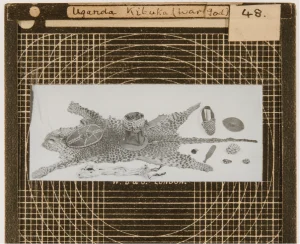
In 1961, Abubaker Kakyama Mayanja, then Minister for Education (in Buganda Government) and renowned nationalist, petitioned the Vice-Chancellor of the University of Cambridge (his alma mater) as regards the return of the Kibuuka (God of War) relics collection among other looted items to Uganda.
In his letter, Mayanja expressed concern over the fact that Uganda, a country that was about to get its independence from the British government, did not have “many such things as these” that embodied the culture and tradition of the Ugandan people.
“Our request is rather that your university will consider sympathetically our great interest in these things especially now that Uganda is about to regain her independence. We do not have many such things as these which portray our cultural past and hence our anxiety, if possible, to get back what you are keeping,” Mayanja’s letter read in part.
The first relics return occurred in 1962 during the independence celebrations, when the Kibuuka relics were repatriated.
The Kibuuka collection is arguably one of the most intriguing material heritage showcases at the Uganda National Museum. This ensemble includes a lower jaw bone, an umbilical cord (traditionally known as mulongo) and genital organs, all encased in respective cowrie-decorated leather cases, traditional head wear, a waist ornament and a leopard hide.
These items, as bizarre as they may sound, as per oral clan histories, belong to a warrior named Kibuuka, who fought for one of Buganda kingdom kings (Kabaka) in the 16th Century against Bunyoro – a rival kingdom.
After meeting his demise in battle, Kibuuka was praised for his courage. He was not only seen as a departed warrior but also deeply revered as the god of war (deity).
In 1906, British missionary ethnographer, Rev. John Roscoe acquired Kibuuka’s relics from a shrine where one of the latter’s oracles had kept them, later sending them off to a Cambridge ethnological museum.
Africa’s cultural relics return home
A new wave of relics repatriation is upon Africa, with stakeholders having noticed that 90% of sub-Saharan Africa’s material cultural legacy is housed outside the continent.
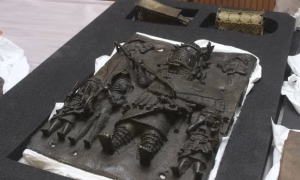
Among the major repatriations is the return of the Benin Bronzes to the Kingdom of Benin in present day Nigeria. Benin Bronzes are a collection of brass relief plaques, dating between 1500–mid-1600s, made for archival display for the ancestral altars of past Obas (kings in the Kingdom of Benin) and Queen Mothers.
These were looted in February 1897 when British Forces captured the City of Benin, burning the Kingdom palace to ash, killing tens of thousands of locals and stealing the bronze plaques which had been stored in one of the Kingdom quarters.
These would later be taken to the UK as “official spoils of war” as the British Museum describes them.
In 2020, through the Legacy Restoration Trust – an independent body formed to act as an intermediary and manage negotiations with foreign museums, Nigeria repatriated 22 Benin Bronzes from Germany and 30 from the United States of America.
As fate would have it, in March 2023, Muhammadu Buhari, then President of Nigeria, declared in a government gazette that the king of Benin, Oba Ewuare II is the rightful owner of the returned Benin Bronzes.
Ghana has also since received 32 Gold artifacts from the United Kingdom government, Namibia got 23 artifacts from Germany, and Kenya received 30 Vigango artifacts from the USA.

Reinforcing culture continuity amidst erosion by modernity
Since the 1962 return, relations between Uganda and the University of Cambridge Museum of Archaeology and Anthropology (MAA) have remained cordial and in June 2024, the former received 39 relics from the same museum, a huge relics repatriation success.
Despite this progress, however, Professor Nicholas Thomas, the Director of the MMA, has acknowledged that the Museum was slow to follow up on the “important 1961 (repatriation) initiative.”
The process to repatriate the 39 artifacts began in 2016 under the ‘Rethinking Uganda Museum’ project, which was conducted in collaboration with the University of Michigan – with Professor Derek Peterson as the principal investigator.
Speaking about the repatriation, Peterson emphasized that the relics should return to the original owners.
“We want to put these objects back into the hands of people who made them meaningful. We want them to live again, not only as museum pieces but as part of Uganda’s public culture,” he said.
Having been dubiously acquired during the 1890s and 1900s by British colonial administrators, missionaries, anthropologists and soldiers, the returned artifacts were selected by two Ugandan curators in November 2022; Uganda’s Commissioner for Monuments and Museums, Rose Mwanja Nkaale and Uganda Museum’s Curator, Nelson Abiti.
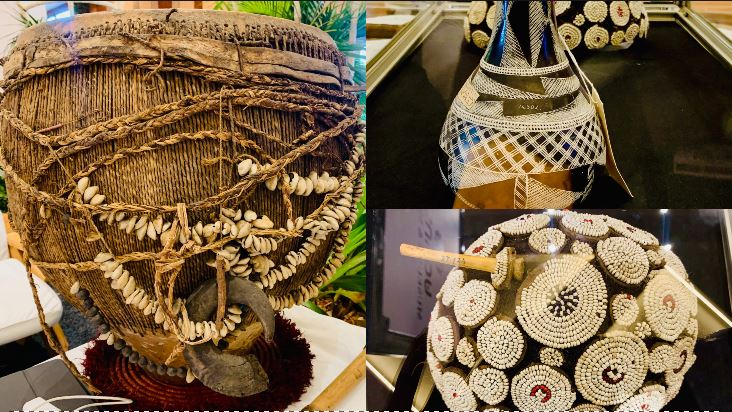
The returned items include human remains taken from the Wamala tombs, a Lubaale vessel from Buganda (acquired 1907), the famous head gear made of human hair worn by the Chief of Lango in the early 1930s which was taken to England in 1937, a royal drum from Bunyoro embellished with cowrie shells, a royal mace (Ddamula) that is believed to have belonged to and used by the former Prime Minister of Buganda Sir Apollo Kaggwa, and a traditional clay pot known as Enjemeko from Ankole (acquired in the 1920s) among others.
Speaking about the significance of this repatriation, the commissioner for Museums Rose Mwanja Nkaale said, “Bringing these items back will help people come to terms with their own collective memory, celebrate their rich histories and identities, and be able to pass this on to future generations.”
According to the State Minister for Tourism, Wildlife and Antiquities Hon. Martin Mugarra, the repatriation of these cultural relics is a crucial step in reinforming culture and conserving heritage that is silently being eaten away by contemporary social dynamics.
Asked if this venture is in anyway transformative in the modern times, Mugarra argued that for a country like Uganda that boasts over 56 tribes and languages, culture plays a huge role in creating a sense of belonging for people adding that the returned items speak to the very essence of tradition from centuries ago.
“We haven’t had these items for over 100 years. They were significant enough for colonialists to take them from Uganda to the UK, clearly, they are important to the people that made them and held them dear. Their return is crucial not only for the Ministry but also for the museums department. We will display and preserve them as part of our cultural heritage,” the Minister said upon receiving the relics packages at Entebbe International Airport in June 2024.
In July 2025, the Ministry of Tourism through the Department of Museums and Monuments repatriated a batch of Karamojong artefacts that have been kept in Kenya for decades, having been ‘collected’ by the late John Wilson, a British national who worked in Uganda’s Karamoja region as an Agricultural Officer during the colonial times.
According to the Ag. Commissioner Museums and Monuments Ms. Jackline Nyiracyiza Besigye, these items hold deep historical, cultural, and symbolic value for the Karamojong people, whose heritage has been in many cases “dispersed.”


Besigye adds that the repatriation not only fulfills the wishes of the Wilson family – for the looted items to eventually be returned to their rightful owners – but also sets a positive precedent for ethical cultural restitution, cross-border cooperation, and mutual respect for African heritage.
The Ministry, in a statement issued in June 2025, notes that these series of repatriations align with the African Union’s call for the return of looted and displaced cultural assets and supports broader efforts to decolonize museum and cultural narratives across the continent.


