
Somewhere in Moyo, at the edge of a sacred forest called Kotilo, the Rwendike chiefdom has been doing something quite extraordinary.
For generations, long before “cultural tourism” became a phrase in any government strategy document, they have been the custodians of a landscape that holds memory, law, medicine, and identity in its roots and canopy.
No billboard. No budget. Just people committed to keeping something alive because they understand what is lost when it disappears.
Stories like this exist in almost every corner of Uganda. And for the past twenty years, one organization has made it its mission to find them, name them, and tell their stories. The Cross-Cultural Foundation of Uganda (CCFU) turns 20 this year and its 7th National Heritage Awards may be one of its most important statements yet.
When the Cross-Cultural Foundation of Uganda opened its doors in 2005, Uganda’s development conversation was dominated by infrastructure, economic growth targets, and sector-specific agendas. Culture sat at the edge of the table, treated more as a curiosity than a resource.
CCFU chose to sit at that edge deliberately.
Their founding argument was simple and, as it turns out, far-sighted; a country that cannot account for its cultural heritage cannot fully account for itself.
Language, traditional knowledge, healing systems, sacred sites, architectural memory, indigenous food systems, and oral histories are not sentimental leftovers from another era – they are living infrastructure. They shape how communities govern themselves, how young people understand who they are, and increasingly, how the world chooses to engage with Uganda as a destination.
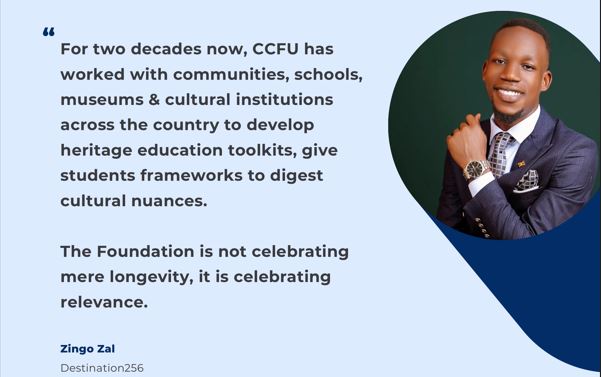
Over two decades, CCFU has worked with communities, schools, museums, and cultural institutions across the country. They developed heritage education toolkits, giving school children frameworks to understand and value what is around them.
They have supported community museums that function as living classrooms, where elders are the teachers and the curriculum is irreplaceable. They have documented endangered languages and indigenous knowledge systems, creating records of things that could otherwise vanish with a single generation.
Twenty years in, the Foundation is not celebrating longevity. It is celebrating relevance.
National Heritage Awards
In 2013, CCFU launched the National Heritage Awards with a clear understanding of what the country was missing, a formal, public mechanism to recognize the people doing the quiet, unglamorous, underfunded work of cultural preservation.
Not governments, not large institutions but individuals, families, communities, and local organizations who wake up every day and choose to hold something together that no one is paying them to hold.
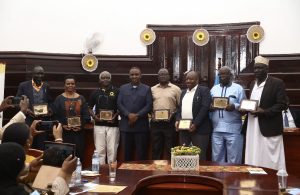
Since then, the awards have recognized 49 beneficiaries across categories of tangible and intangible heritage, with a media category recently added, bringing the total to over 50 heritage champions given national recognition.
Each winner receives UGX 2.5 million and a plaque. The money is modest. CCFU is candid about that. But the organization frames the real value in terms that are harder to put a figure on.
“We don’t give a lot of money,” CCFU said, “but we give recognition showing you that we see you and appreciate the work that you do.”
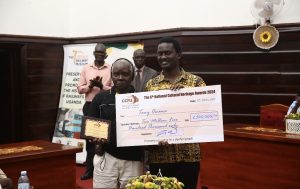
That is not a small thing in a country where so much cultural work goes unseen. Recognition changes the story. It signals to communities that their custodianship has value beyond their immediate circle. It creates public record. It inspires others to step forward. And for the winners themselves, it often opens doors that funding applications and proposals could not.
This year, the 7th edition of the awards arrives as an anniversary gift to Uganda. CCFU turns 20 in 2026, and rather than marking the milestone with a gala or a retrospective document, the organization has chosen to turn the spotlight outward.
Nominate your heroes. Find them. Name them. Tell their story to the country.
Nominations are now open and will close around 12 May 2026. A jury of cultural experts will review nominations and select winners, who will be honored at a ceremony on 20 May 2026.
The nomination categories are deliberately broad, because heritage itself is broad. You can nominate an individual, a family, a community, an institution, a media personality or media house.
The categories span endangered languages, indigenous knowledge systems, traditional foods and healing practices, historical buildings and sacred sites, artistic and craft expressions, and heritage storytelling through journalism, film, radio, podcasts, photography, or digital media.
Across Uganda, people are doing work that the formal heritage sector often cannot reach; the Nubian community in Bombo maintaining the historic Masjid Al Noor Mosque, the Tooro Botanical Gardens preserving indigenous plant knowledge that bridges traditional medicine and environmental education.
These are not tourist attractions waiting to be developed. They are active, living practices, and the people behind them are making daily choices to keep them that way.
Here is the shift that has happened in global travel, and Uganda is well-positioned to lead it if the country pays attention. Tourists, particularly those willing to travel long distances and spend meaningfully, are no longer primarily looking for scenery. They are looking for an encounter. They want to understand a place through the people who live in it, the knowledge they carry, and the practices they sustain.
Also read: Inside CCFU’s Multipronged Strategy to Safeguard Intangible Cultural Heritage
A gorilla trek is unforgettable. But a visitor who also sits with a traditional healer in the Albertine region, learns to read a sacred forest through the eyes of its custodian, or watches bark cloth being made by a family who has practiced the craft for five generations, that visitor leaves with something that cannot be replicated or compared. They become advocates. They come back. They send others.
This is exactly what authentic cultural tourism looks like. And it cannot be manufactured by a tourism board working alone. It requires the ecosystem that CCFU has been quietly building for twenty years, educated communities, respected custodians, documented knowledge, and recognized heritage champions whose work has been given visibility and dignity.
Every person the Heritage Awards celebrates is, in practical terms, a cultural tourism asset. Not as a commodity, but as a living node of experience, knowledge, and story that visitors can genuinely engage with. Investing in their recognition is investing in the depth of Uganda’s tourism offer.
Think about who you know. The elder who still practices traditional justice under a sacred tree that has held community disputes for three hundred years. The journalist who has spent years archiving oral histories before the last witnesses are gone. The young designer who went back to bark cloth when everyone told her it had no market. The family who still ferments sorghum using a recipe no one else remembers.
To nominate, visit https://bit.ly/HeritageAwards26
Uganda’s cultural heritage is not a museum exhibit, and it will not survive as one. It survives in people, in practice, in the daily choice to carry something forward. The CCFU Heritage Awards exist to say, publicly and formally, that this work is seen. and Twenty years in, that statement is not getting quieter. It is getting more necessary.