





A landmark chimpanzee census conducted in Bwindi Impenetrable National Park has yielded a population estimate of 426 chimpanzees widely distributed across this UNESCO World Heritage site.
Uganda Wildlife Authority (UWA) made the announcement in a press release issued today, and the census results were officially launched by the State Minister for Tourism Hon. Marin Mugarra.
This inaugural census, carried out in two comprehensive sweeps between May and September 2025, provides the first scientifically robust baseline for chimpanzee populations in this globally significant ecosystem, which marks a transformative moment for primate conservation in Uganda.
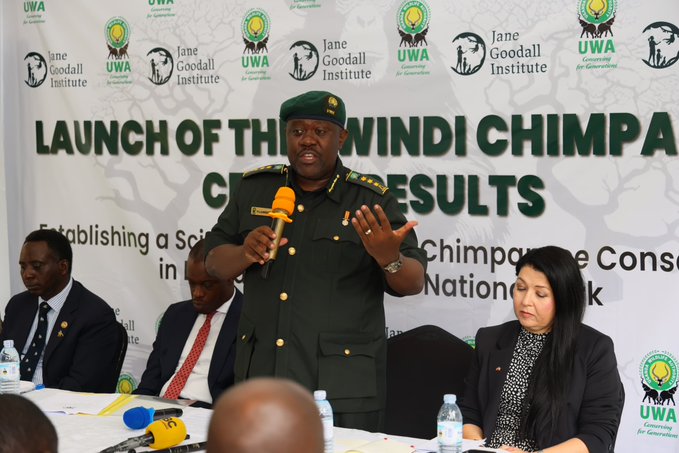
Speaking at the results launch, Hon. Mugarra emphasized the importance of science-led conservation.
“The confirmation of a substantial and widely distributed chimpanzee population in Bwindi strengthens our understanding of the park as a critical habitat for great apes and reinforces the need to manage protected areas using sound scientific data, particularly in the face of climate change, habitat pressure, and growing demand for land and resources,” he said.
The census was led by the Jane Goodall Institute (JGI) Uganda in partnership with Uganda Wildlife Authority (UWA) and the Greater Virunga Transboundary Collaboration (GVTC), covering 320.9 square kilometres across all four tourism sectors of Bwindi: Buhoma, Ruhija, Nkuringo, and Rushaga, and implemented alongside the park’s sixth mountain gorilla census.
Speaking at the launch, UWA Executive Director, Dr. James Musinguzi said the census provides a strong scientific foundation for conservation decision-making.
“For the first time, we have clear scientific evidence confirming a substantial and widely distributed chimpanzee population within Bwindi. This strengthens our ability to plan, protect, and manage the park using evidence-based approaches, while ensuring that chimpanzees receive conservation attention alongside other great apes,” he said.
Researchers employed standardized line-transect survey methods, including Standing Crop Nest Count and Marked Nest Count approaches. Over 60 trained personnel, 70% of whom were UWA staff, participated in the census, building critical local capacity for future monitoring efforts.
The estimate of 426 chimpanzees represents a comprehensive understanding of how these great apes utilize the park’s diverse ecosystems. The two-phase methodology allowed researchers to account for seasonal movements and variations in chimpanzee behavior, thus ensuring the most accurate assessment possible.
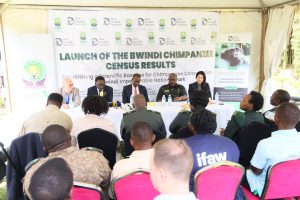

The Executive Director of JGI Uganda, Mr. James Byamukama, noted that the census addresses long-standing knowledge gaps.
“The evidence confirms that chimpanzees are not a marginal presence but an integral component of Bwindi’s ecosystem. This baseline will guide conservation planning, protected area management, and regional biodiversity strategies, while supporting Uganda’s international conservation commitments,” he said.
The Bwindi Chimpanzee Census feeds into the ideals of Uganda’s National Chimpanzee Conservation Strategy (2023/24–2032/33) by providing site-specific, scientifically robust population data to support evidence-based implementation of the Strategy, strengthen monitoring of population trends and habitat integrity, guide targeted law enforcement, and aligning conservation investments with priority chimpanzee landscapes.
One of the most significant findings is the ecological overlap between chimpanzees and mountain gorillas, with field teams documenting nesting sites of both species in proximity.
“Findings confirm that chimpanzees are widely distributed throughout the park, occupying habitats ranging from mixed Afromontane forest to higher-elevation montane ecosystems. Under conservative modelling assumptions, the census estimated an average density of 1.33 chimpanzees per square kilometre, challenging earlier assumptions that the species was rare or confined to marginal areas,” UWA reveals in the press release.
“The survey detected minimal signs of human disturbance across transects, suggesting that large portions of the park remain ecologically intact and capable of sustaining viable chimpanzee populations,” the results indicate.
This positions Bwindi among the few ecosystems globally where multiple great ape species coexist within a single protected landscape, opening new avenues for research into interspecies interactions, disease dynamics, and climate resilience in tropical forests.
The partnership with the Jane Goodall Institute, founded by the world’s preeminent primatologist, brings decades of expertise in chimpanzee research to the Ugandan context.
With this census complete, UWA and its partners now possess the foundational knowledge necessary for targeted conservation interventions;
- Protecting critical habitat corridors identified during the census.
- Strengthening community engagement programs in areas adjacent to chimpanzee ranges.
- Developing evidence-based management plans tailored to chimpanzee behavioral patterns.
- Establishing regular monitoring protocols to track population trends over time.
The census establishes a critical scientific baseline for tracking chimpanzee population trends, fundamentally redefining Bwindi not only as a sanctuary for mountain gorillas but as a complex great ape ecosystem of global significance.


