




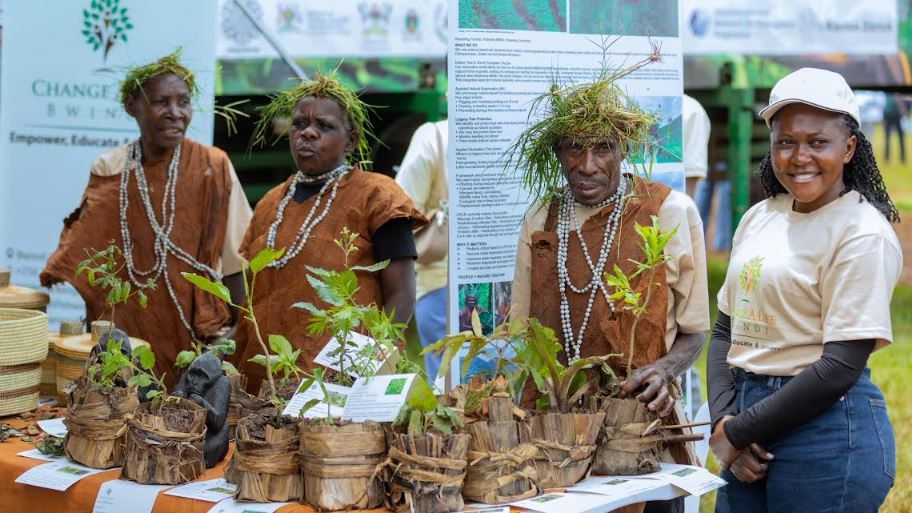
One of the key highlights at this year’s World Wildlife Day celebrations held in Entebbe on Tuesday was seeing representatives of the Batwa community holding court not as a dancing troupe or mere “cultural showcase” but as custodians of knowledge on medicinal plants.
Having travelled all the way from Kanungu District in South Western Uganda, the Batwa community gave the day’s celebration more meaning with a practical exhibition of their ancestral knowledge on medicinal plants.
Uganda anchored this year’s World Wildlife Day celebrations on medicinal plants, the theme “Medicinal and Aromatic Plants: Conserving Health, Heritage and Livelihoods,” speaking to various aspects of their essence and the challenges facing their existence and use.
Once forest dwellers of South Western Uganda’s dense forests including Bwindi, Echuya and Mgahinga, the Batwa were evicted in the early 1990s when the government gazetted the forest as park land – primarily to pave way for the conservation of gorillas.
These hunter-gatherer stewards of the forests had inhabited these mountainous lands for over 60,000 years, during which they mastered the art of using medicinal plants to treat various ailments as one of the representatives, David Kakuru, told Prime News during the Wildlife day event.
Uganda is home to numerous medicinal plants which are used in various forms including but not limited to treatment for human and animal diseases, pesticides in fruit and other crop farming.
Plants like Warburgia ugandensis which is used to treat cough and sore throat, colds, gastro-intestinal disorders and malaria among others, Prunus Africana which is used to treat prostate gland enlargement and Vernonia amygdalina which treat malaria but is also used as a pesticide are a common sight in Uganda.
The knowledge and use of, however, is not as common as their appearance, except in communities like the Batwa where herbal medicine is the first line of treatment.

Call for Medicinal plant documentation
David Kakuru is in his mid 70s now, meaning he lived the original Batwa way of life before the eviction happened.
Kakuru noted that the transition from hunter-gatherer to semi-modern living has immensely affected their diet, faith and day-to-day life.
Bits and pieces of their tradition have, however, survived the tides of modernity, key among these being the use of traditional herbs to soothe and remedy sickness.
“We didn’t have modern hospitals back there but our people lived to even over 100 years. We treated illnesses with herbs and some of these we are showcasing today,” Kakuru said.
He, however, worries that with the change in lifestyle – with families scattered all over the place around the Park’s periphery unlike in the forest where they huddled together as a community – knowledge is not being transferred from one generation to another as previously done.
Most of this knowledge and skill impartation was done during the social gatherings around the fire place as families roasted bounties from the day’s hunt.

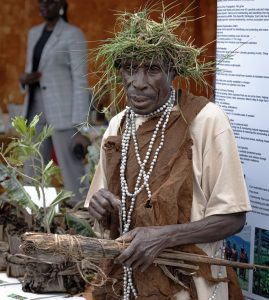
Christina Katushabe, also team lead of the Batwa community said their participation in this national event is a huge milestone.
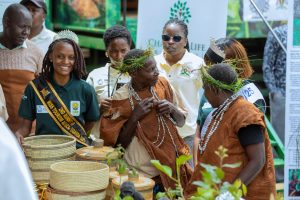
The group displayed various medicinal plants and demonstrated how different herbs are used to treat common ailments such as stomach disorders, respiratory infections, and skin diseases.
Katushabe called on the various stakeholders to make haste in documenting the medicinal plants and processes of administration sighting the old age of the people who are well-versed with the practice.
She fears that as the elders die, they take this knowledge with them so new generations will not be as savvy.
“Most of those with deep knowledge are between 60 and 70 years old. We need more support to document this knowledge for the next generation,” Katushabe urged, calling on government to prioritize profiling and documenting indigenous communities rich in traditional, medicinal knowledge.
Even in the contemporary times, Uganda is no stranger to the undeniable magic, or rather science, of herbal medicine.
When the COVID-19 pandemic ravaged the nation as it did the rest of the world in 2020-2021, a Ugandan pharmacologist and ethnobotanist – Patrick Ogwang, who had overtime experimented with herbal medicine gave millions a second chance at life with his Covidex tonic.
As the last waves of the pandemic swept some parts of Uganda in 2021 amidst dwindling resources, Covidex, a herbal extract from 3 indigenous plants would be okayed by the Uganda Drug Authority as an emergency treatment for Covid-19. Users reported relief from the symptoms and hospitals had a reliable alternative to treatment options.
What stakeholders say

Speaking at the launch of the Wildlife Day celebratory activities in February, Hon. Martin Mugarra Bahinduka, the Minister of State for Tourism emphasized that medicinal plants are not only the foundation of traditional healthcare systems but also an economic lifeline for millions of rural communities globally.
“Medicinal and aromatic plants represent far more than botanical specimen and as we face unprecedented challenges from climate change, habitat loss and unsustainable exploitation, the conservation of these plants has never been more crucial for our collective future,” he said.
According to the Minister, around 60,000 plant species are used globally for medicinal, nutritional, and aromatic purposes, with roughly 500,000 tons traded annually. He added that the market is valued at $60 billion USD and is growing at 7% per year, yet 90% of these plants are still harvested from the wild, creating severe pressure on ecosystems and threatening long-term availability.
Speaking at the World Wildlife Day celebration on Tuesday, Dr. James Musinguzi, the Uganda Wildlife Authority (UWA) Executive Director announced that UWA is diversifying tourism products by introducing botanical modern trails, where tourists and researchers can encounter and learn about the medicinal plants Uganda is blessed with.

In his remarks at event in Entebbe, Col. (Rtd) Tom Butime, the Minister for Tourism Wildlife and Antiquities said that more than two-thirds of Ugandans rely on traditional medicine to cure illnesses.
The Minister stated that over 20 percent of medicinal plant species globally are threatened with extinction due to habitat loss, overharvesting, and climate change.
He called for urgent action, including sustainable harvesting practices, documentation of indigenous knowledge, domestication of medicinal plants, and stronger community involvement in conservation efforts.


